

Asclepias tuberosa (Butterfly Milkweed) Seed Packet
Asclepias tuberosa (Butterfly Milkweed) Seed Packet
Subject to confirmation.
Couldn't load pickup availability
Quick View - Seed Mix Specifications
Quick View - Seed Mix Specifications
Pure Live Seed
Pure Live Seed
Seed is provided in Pure Live Seed (PLS) unless otherwise stated.
Pure Live Seed (PLS) expresses the viable seed content of a seed lot using its purity and germination or viability test results. It helps you compare seed lots and calculate how much bulk seed is needed to meet a specified PLS planting rate.
PLS weight and bag weight
PLS weight is not the same as the total weight of seed in a bag. For example, a lot with 80% purity and 75% viability contains 60% PLS: 80 × 75 ÷ 100 = 60. Supplying 10 lb PLS from that lot requires about 16.67 lb of bulk seed.
Use the current seed test and the stated basis of the mix specification. Germination calculations may include applicable hard or dormant seed. Seed-count estimates also require the number of seeds per pound; PLS alone does not provide a seed count.
What to check when buying a mix
Check whether each rate is stated in PLS pounds, bulk pounds, or a combination. A mix with both bases should not be described as having an all-PLS total.
PLS does not remove weed seeds or guarantee establishment. Review the seed label and analysis for weed content, and match site preparation, planting conditions and follow-up management to your project.
Sources: USDA NRCS, Understanding Pure Live Seed and The Importance of Seed Quality for Natural Resource Conservation.
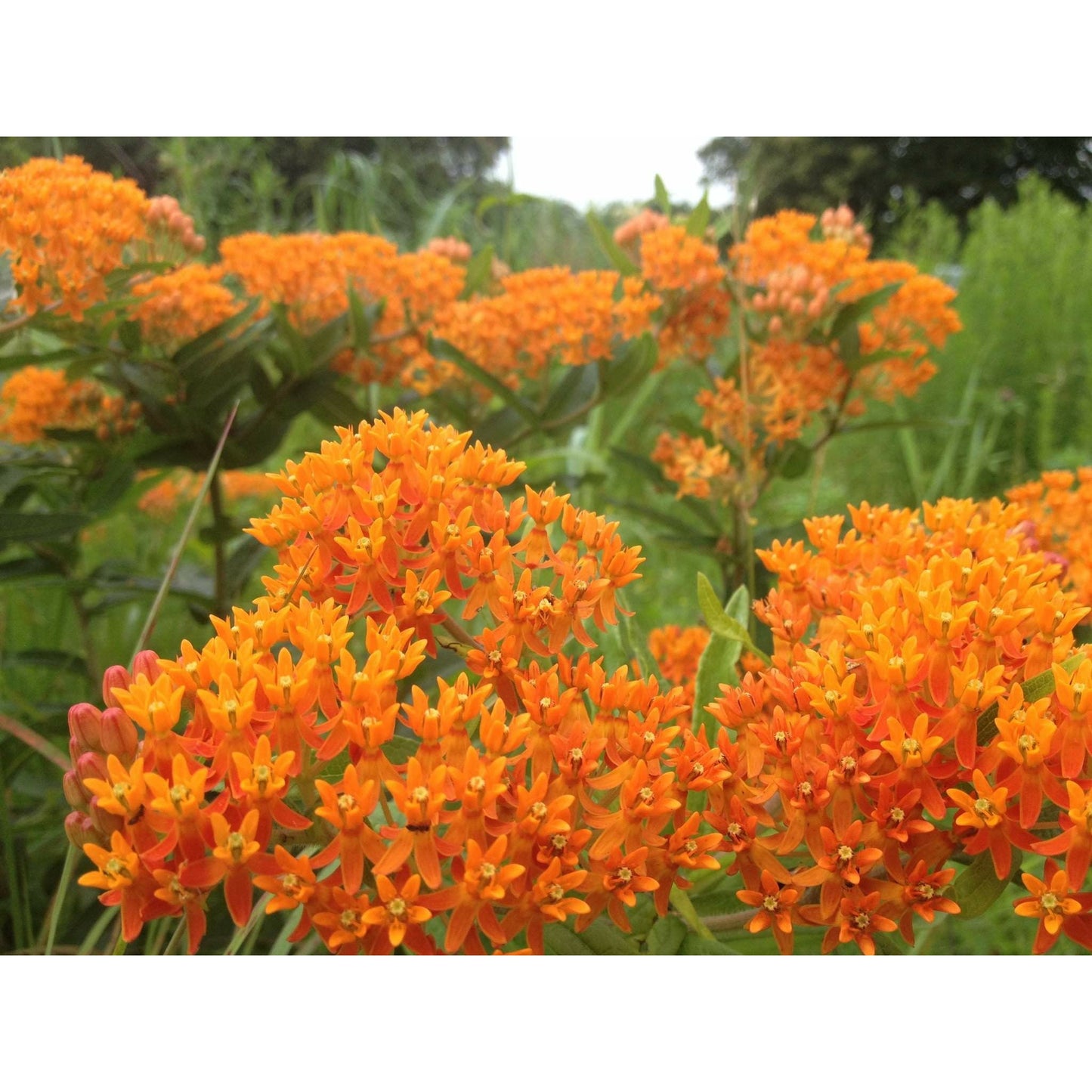
Grow butterfly milkweed (Asclepias tuberosa) from seed for orange summer flowers in sunny, well-drained ground. This packet is listed as containing approximately 200 seeds. The species suits dry prairie plantings, pollinator gardens, and sunny borders where water does not collect around the roots.
Seed-grown plants may take two to three years to establish and flower. Choose a permanent location before planting: mature plants develop a deep taproot and are difficult to transplant. A prepared seedbed with little competition gives young plants room to develop.
Butterflies visit the flowers for nectar, and monarch caterpillars feed on the leaves. Mature plants form clumps with several flowering stems. Follow the packet’s sowing instructions, and avoid poorly drained sites where crown rot can develop.
Plant specifications & ecological relationships
Key growing facts
| Sunlight | Full sun |
|---|---|
| Soil moisture | Mesic to dry |
| Height | 1-2½ ft |
| Bloom season | Early to mid-summer; a second bloom sometimes occurs in late summer to early autumn |
Native landscape companions
For full sun and dry-mesic soil, consider these native plants alongside Asclepias tuberosa:
| Companion plant | Height |
|---|---|
| Old Field Goldenrod (Solidago nemoralis) | About ½-2½ ft |
| Copper-shouldered Oval Sedge (Carex bicknellii) | About 1½–2½ ft |
| Black-eyed Susan (Rudbeckia hirta) | About 1-2½ ft |
| Prairie Cinquefoil (Drymocallis arguta) | Plant size varies; the Montana account reports stems about 10–31 inches tall. |
These landscape suggestions combine overlapping growing needs with documented plant associations. Match soil, seasonal wetness and mature spread to your site. Remnant records are described separately under Plant communities & associates.
Show / hide ▾Growing & planting details
| Growth habit | Young plants have a single stem; older plants produce multiple stems from the taproot crown |
|---|---|
| Root form | Taproot |
| Soil pH | Prefers acidic soil; numerical pH limits are not established |
| Cultivation hardiness zones | Zones 3a–9b (general cultivation guidance) |
| Drought tolerance | Drought tolerance reported in cultivation guidance; establishment needs and duration are not specified. |
| Deer browsing | Deer resistance reported in cultivation guidance; browsing remains possible. |
| Salt tolerance | Salt tolerance reported in cultivation guidance; dose and exposure route are not specified. |
| Plant toxicity | Poison characteristics are reported; listed parts: flowers, fruits, leaves, roots, sap/juice, stems. Pet safety is not established. |
Plant identification & seed reference
| Botanical name | Asclepias tuberosa |
|---|---|
| Other common names | butterfly weed; Butterfly Milkweed; Butterfly Weed; Chiggerflower; Common Butterfly-weed; Indian Paintbrush; Milkweed; Pleurisy Root |
| Seed germination | USDA lists cold stratification as not required; seed-lot response may vary. |
| Plant family | Asclepiadaceae |
| Seeds per pound — reference estimate | 70000 |
Show / hide ▾Plant communities & associates
Illinois plant communities
Mesic black-soil prairie — central Illinois
Recorded at Loda Cemetery Prairie (Iroquois County), Prospect Cemetery Prairie (Ford County). INHS identifies these sites as remnants of this community.
Selected native plants from the same remnant records:
- Sorghastrum nutans
- Andropogon gerardii
- Sporobolus heterolepis
- Eryngium yuccifolium
- Silphium laciniatum
- Parthenium integrifolium
These inventories include edges and disturbed patches. Shared remnant records do not establish that every plant grows together in one microsite.
Show / hide ▾Native range & C-value
State nativity describes a broad range. Use the Chicago-region assessment for local context; a state listing does not establish county nativity.
| Wetland indicator — Corps Chicago 2017 table | UPL |
|---|---|
| C-value — Chicago region, Flora 2017 | 8 |
| Chicago-region native — Flora 2017 | Yes |
| Native range — U.S. states | Alabama; Arizona; Arkansas; Colorado; Connecticut; Delaware; Florida; Georgia; Illinois; Indiana; Iowa; Kansas; Kentucky; Louisiana; Maine; Maryland; Massachusetts; Michigan; Minnesota; Mississippi; Missouri; Nebraska; New Hampshire; New Jersey; New Mexico; New York; North Carolina; Ohio; Oklahoma; Pennsylvania; Rhode Island; South Carolina; South Dakota; Tennessee; Texas; Utah; Vermont; Virginia; West Virginia; Wisconsin |
| County nativity | Cook County, Illinois — native-remnant population documented in the 2000 survey. Partial county coverage; other counties have not yet been assessed here. |
Show / hide ▾Pollinators & wildlife
Caterpillars & other plant-feeding insects
This plant has published caterpillar host records for the butterflies and moths listed below. These are larval feeding relationships, separate from adult nectar visits. The records span a North American literature compilation and do not establish that every insect occurs locally or uses only this plant.
Butterflies & skippers
- Danaus gilippus — Queen
- Strymon melinus — Gray Hairstreak
Moths
- Cycnia tenera — Delicate Cycnia, Dogbane Tiger Moth
- Euchaetes egle — Milkweed Tussock Moth or Milkweed Tiger Moth
Other insect & wildlife relationships
Caterpillars this plant can feed
Monarch; Gray Hairstreak; Queen; Milkweed Tussock Moth.
- Nectar: The flowers provide nectar for butterflies and other insects.
Additional published species records; Illinois insect occurrence is not established by this account. These records do not guarantee that every insect occurs at your planting site.
Show / hide ▾Frequently asked questions
What are the ideal growing conditions for Butterfly Milkweed?
Light: Full sun. Soil moisture: Mesic to dry.
How do I germinate and establish Butterfly Milkweed from seed?
USDA lists cold stratification as not required; seed-lot response may vary.
Is Butterfly Milkweed deer and herbivore resistant?
Deer resistance reported in cultivation guidance; browsing remains possible. Even plants described as resistant may be browsed. Use physical protection where deer damage is a concern.
When should I expect Butterfly Milkweed to bloom?
Typical flowering period: Early to mid-summer; a second bloom sometimes occurs in late summer to early autumn. Timing varies with location and weather.
Show / hide ▾Sources & ecological notes
Landscape companion selection: Natural Communities compared the growing requirements shown on these species pages with selected source records: Mesic black-soil prairie — Loda Cemetery Prairie — Central Illinois. The shortlist is a planting-design inference. A shared record does not establish adjacency, identical soil requirements, local seed origin, or a tested planting combination. Regional synthesis records retain their documented focal-to-associate scope.
Illinois communities & local records: INHS: Loda, Prospect and Weston prairie records; Shouba & Murray: Wolf Road Prairie, Cook County (2000).
Native range & ecological ratings: Flora of the Chicago Region (2017), via Universal FQA; USACE Chicago FQA (2017); Kew WCVP / Plants of the World Online.
Growing conditions & other references: Illinois Wildflowers, John Hilty; USDA NRCS PLANTS; Patrick Goggin: Wisconsin native plant guide, p. 75; NC State Extension Plant Toolbox.
Wildlife records: Shropshire & Tallamy: caterpillar hosts (2025).
Native range does not identify the origin of the seed or plants offered. Community and wildlife records apply to the locations and conditions described.
Research notes & credits
USACE/ERDC fqadata — Chicago Region FQA 2017. Herman, B., Sliwinski, R. & Whitaker, S. (2017), Chicago Region FQA Calculator; distributed by USACE/ERDC in fqadata under CC0. Values may differ from Flora of the Chicago Region (2017). CC0 dedication.
Range data: World Checklist of Vascular Plants, Royal Botanic Gardens, Kew; 4 June 2026 release, accessed 7 September 2026. © The Trustees of the Royal Botanic Gardens, Kew. CC BY 3.0; selected and reformatted. Kew cannot warrant the quality or accuracy of these data. This use has no Kew endorsement.
Caterpillar host records: Shropshire, K.J. & Tallamy, D.W. (2025), Lepidoptera of North America, Supplement 1. Contains information from this database made available under the Open Database License (ODbL 1.0). Natural Communities selected species-level records and screened source qualifications. The complete selection and transformation instructions for this page are available below under the same license.
Flora rating attribution: Kenneth Johnson (2018), Flora of the Chicago Region UFQA Database, following Gerould Wilhelm and Laura Rericha (2017), Flora of the Chicago Region: A Floristic and Ecological Synthesis. Individual rating facts are presented with original commentary; the calculator’s software license is not treated as a license for the underlying Flora publication.
Caterpillar research records
Plant: Asclepias tuberosa
Record scope: Host literature synthesis; no county nativity or local insect occurrence inferred.
Shropshire & Tallamy (2025) · Original research dataset · Reuse license: ODbL-1.0
| Plant names in the source | Source insect record IDs |
|---|---|
| Asclepias tuberosa | 203712, 203785, 205052, 211907 |
How these records were selected
To reproduce this selection, use the “UDELep May 2025” worksheet in the original research dataset.
- Match the insect record IDs above to column A (UDLepID). Within each table row, pair every listed insect ID with every listed source plant name.
- Use the first two words in column H for the insect’s scientific name, column E for its common name, and column AB for its source category.
- Treat the selected pairs as reported caterpillar host records. Keep all other source fields unchanged and outside this selected table. Include no other rows or host pairs.
- Group butterflies and skippers together, and the other categories as moths. Retain the source’s exotic-category labels and sort display names by scientific insect name.
Growing guidance: Illinois Extension — Keeping deer out of the yard and garden. Selected facts in original wording. General deer advice is not a species resistance rating.
Botanical Profile & Ecological Characteristics
Monarch Butterflies are fully and exclusively dependent upon milkweeds for laying eggs and for larva food source and they can nectar. These plants were once so plentiful they were literally called weeds because they were problematic in agricultural fields. However, that's no longer the case with regular Glyphosate treatments to agricultural fields wiping out all "weeds". With fragmentation, global climate change, pollution, and other threats this is a major problem for Monarch butterflies that heavily depend upon the milkweed and other native plants. Monarch caterpillars need milkweeds, but also nectar sources that many native flowers provide. Help keep these going! Please consider your part in this planet, plant Monarch food sources including milkweed and other native plants.The best native milkweed for landscaping and arguably the single best native plant for landscaping, Asclepias tuberosa (Butterfly Milkweed) is quite a plant. Its compact growth habit and beautiful and rarer intensive orange colored flower are what make it the most popular plant plus the ability to host the monarch caterpillar. You really can‚¬„¢t go wrong aesthetically with this plant, but it can be a bit finicky to grow in moister and heavy clay soils. Choose you spot well and you will have a lifetime of orange bliss!!
Shipping & Care
Shipping & Care
Seed ships all year and typically ships within a week of an order being placed.
We have attempted to put together some basic information regarding native seed installation, establishment, and maintenance. We hope you find it helpful. If you need further assistance on native seed establishment, please schedule a free consolation call here.
Consultation Services
Ecosystem Restoration Considerations
Native Seed Establishment Best Management Practices
Native Seed Stratification Best Management Practices
Solving a Site Problem? Get Expert Advice + Get Store Credit
Whether you're fighting severe erosion, replacing invasive species, designing a pollinator haven, or seeding large acreage, choosing the wrong species wastes time and money. Talk 1-on-1 with a restoration ecologist to map out the exact species, plug counts, or seed mixes for your soil and goals. Book a consultation and get all or a portion credited directly back to your order.