


Cinna arundinacea (Wood Reed Grass)
Cinna arundinacea (Wood Reed Grass)
How many plants do you need?
Calculate plants & flatsEstimate quantities from your planting area and species-appropriate spacing, then round up to whole flats.
Eligible choices for this product:
- 38 Plug Flat
No projected availability.
Subject to confirmation.
Couldn't load pickup availability
How much seed do you need?
Calculate seed quantitiesEnter your planting area and the rate for this species, or add species to plan a custom mix.
Pure Live Seed
Pure Live Seed
Seed is provided in Pure Live Seed (PLS) unless otherwise stated.
Pure Live Seed (PLS) expresses the viable seed content of a seed lot using its purity and germination or viability test results. It helps you compare seed lots and calculate how much bulk seed is needed to meet a specified PLS planting rate.
PLS weight and bag weight
PLS weight is not the same as the total weight of seed in a bag. For example, a lot with 80% purity and 75% viability contains 60% PLS: 80 × 75 ÷ 100 = 60. Supplying 10 lb PLS from that lot requires about 16.67 lb of bulk seed.
Use the current seed test and the stated basis of the mix specification. Germination calculations may include applicable hard or dormant seed. Seed-count estimates also require the number of seeds per pound; PLS alone does not provide a seed count.
What to check when buying a mix
Check whether each rate is stated in PLS pounds, bulk pounds, or a combination. A mix with both bases should not be described as having an all-PLS total.
PLS does not remove weed seeds or guarantee establishment. Review the seed label and analysis for weed content, and match site preparation, planting conditions and follow-up management to your project.
Sources: USDA NRCS, Understanding Pure Live Seed and The Importance of Seed Quality for Natural Resource Conservation.
Weight Conversions lbs. to oz.
Weight Conversions lbs. to oz.
0.01 pounds = 0.16 ounces
- 0.1 pounds = 1.6 ounces
- 0.25 pounds = 4 ounces
- 0.5 pounds = 8 ounces
- 0.75 pounds = 12 ounces
- 1.00 pounds = 16 ounces
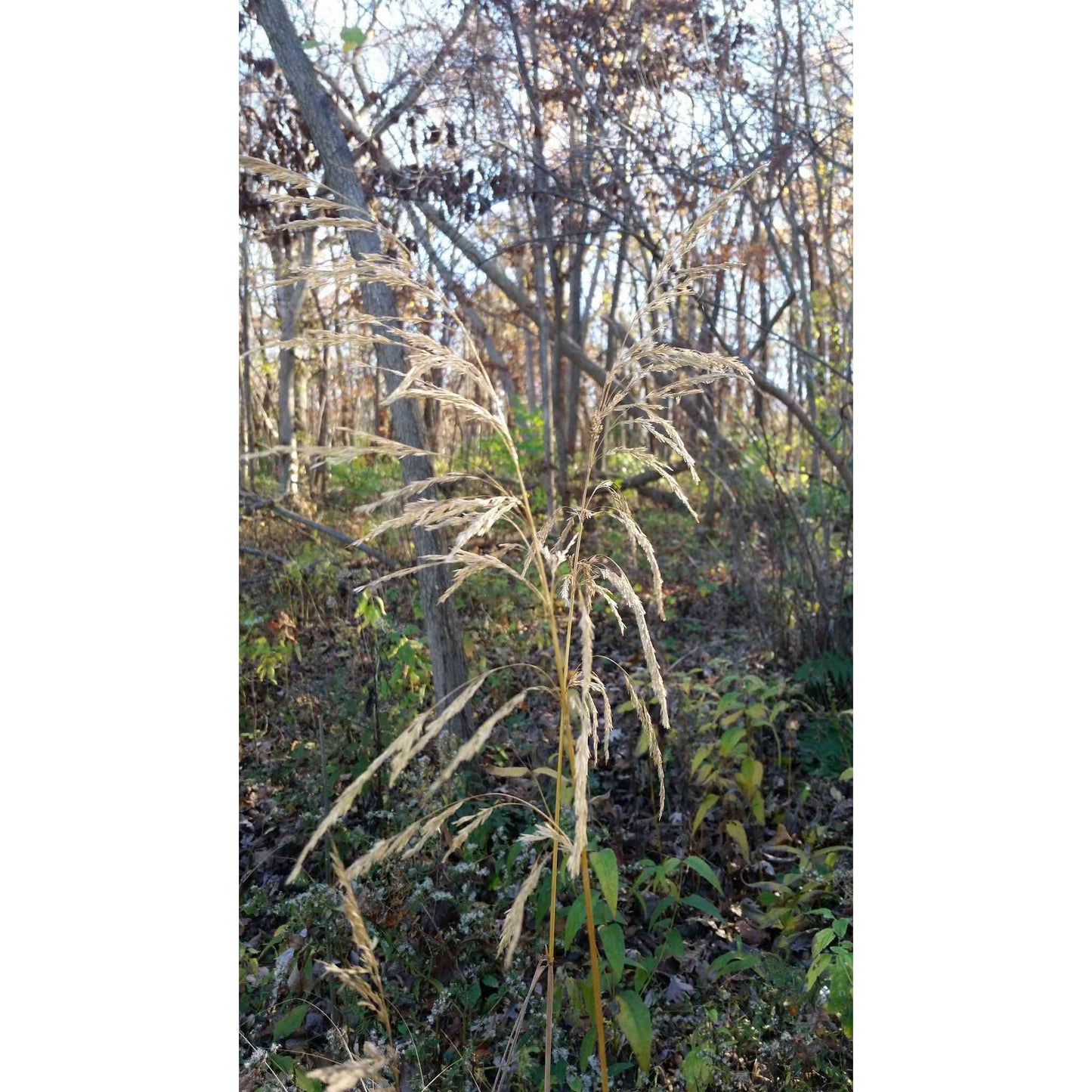
Wood reed grows through summer beneath partial light and flowers late in the season. Its tall stems suit fertile woodland ground that stays consistently moist.
For Cinna arundinacea, choose filtered sunlight or light shade and slightly wet to consistently moist soil. Recorded habitats include floodplain woods; Swamps; Thickets; Small woodland openings; Woodland seeps; Damp savannas. Reported height: 3-5 ft.
Growth habit: scattered plants or small tufts; may form small vegetative colonies. Allow space for this growth between neighboring plants over several seasons, rather than spacing only for the size of a young plant.
Plant specifications
Key growing facts
| Sunlight | Filtered sunlight or light shade |
|---|---|
| Soil moisture | Slightly wet to consistently moist |
| Height | 3-5 ft |
| Bloom season | Late summer |
Show / hide ▾Growing & planting details
| Growth habit | Scattered plants or small tufts; may form small vegetative colonies |
|---|---|
| Root form | Fibrous roots; Rhizomes |
| Soil pH | 4.0–8.5 |
| Drought tolerance | Low |
| Deer browsing | The Illinois account describes little white-tailed deer browsing. |
| Salt tolerance | None |
Plant identification & seed reference
| Botanical name | Cinna arundinacea |
|---|---|
| Other common names | common wood reed |
| Plant family | Poaceae |
Plant characteristics
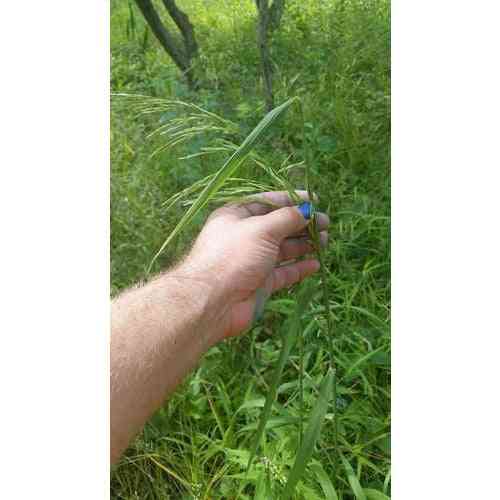
Cinna arundinacea (Wood Reed Grass) is charming grass that is common in our oak woodlands. It is taller, however.
- Flower Time June, July, August
Show / hide ▾Plant communities & associates
Illinois woodland and stream communities
Middle Fork Woods, Vermilion County (1999–2002 survey). Recorded in: dry-mesic upland forest — mature second growth; mesic ravine forest; dry-mesic savanna — old growth with canopy closure; southern flatwood forest and ephemeral pond; dry upland bluff — east-facing river slope; dry upland bluff — west-facing creek slope; dry-mesic upland forest — immature second growth; perennial stream corridor.
Dry-mesic upland forest — mature second growth — selected native associates: Carex pensylvanica, Carex rosea, Carex blanda.
Mesic ravine forest — selected native associates: Geranium maculatum, Phlox divaricata, Asarum canadense.
These plants share a recorded habitat; they were not necessarily found in the same small plot.
Spring Bay Fen Nature Preserve — wet-mesic floodplain forest
Surveyed in 2007, 2008 and 2011. Wet-mesic floodplain forest recorded separately from the adjoining fen. These dated records do not establish presence today.
Other native plants recorded in this surveyed community: Acer nigrum, Acer saccharinum, Agastache nepetoides, Amorpha fruticosa, Anemone canadensis, Arisaema dracontium, Arisaema triphyllum, Blephilia hirsuta, Carex blanda, Carex emoryi.
Murphy, Phillippe & Ebinger 2021, Appendix 1. Selected associates from the same community; records do not show immediate neighbors or prescribe planting ratios.
Spring Bay Fen Nature Preserve — tall shrub fen
Surveyed in 2007, 2008 and 2011. Tall shrub fen on Lena muck, recorded separately from the adjoining forest and filled upland. These dated records do not establish presence today.
Other native plants recorded in this surveyed community: Acer saccharinum, Amorpha fruticosa, Asclepias incarnata, Blephilia hirsuta, Bolboschoenus fluviatilis, Caltha palustris, Carex hystericina, Carex stipata, Cephalanthus occidentalis, Chelone glabra.
Murphy, Phillippe & Ebinger 2021, Appendix 1. Selected associates from the same community; records do not show immediate neighbors or prescribe planting ratios.
Show / hide ▾Native range & C-value
State nativity describes a broad range. Use the Chicago-region assessment for local context; a state listing does not establish county nativity.
| Wetland indicator — NWPL 2022 Midwest | FACW |
|---|---|
| C-value — Chicago region, Flora 2017 | 5 |
| Chicago-region native — Flora 2017 | Yes |
| Native range — U.S. states | Alabama; Arkansas; Connecticut; Delaware; Georgia; Illinois; Indiana; Iowa; Kansas; Kentucky; Louisiana; Maine; Maryland; Massachusetts; Michigan; Minnesota; Mississippi; Missouri; Montana; Nebraska; New Hampshire; New Jersey; New York; North Carolina; North Dakota; Ohio; Oklahoma; Pennsylvania; Rhode Island; South Carolina; South Dakota; Tennessee; Texas; Vermont; Virginia; West Virginia; Wisconsin |
| County nativity | Not yet verified; occurrence records do not establish nativity. |
Show / hide ▾Frequently asked questions
What are the ideal growing conditions for Wood Reed Grass?
Light: Filtered sunlight or light shade. Soil moisture: Slightly wet to consistently moist.
Is Wood Reed Grass deer and herbivore resistant?
The Illinois account describes little white-tailed deer browsing. Even plants described as resistant may be browsed. Use physical protection where deer damage is a concern.
When should I expect Wood Reed Grass to bloom?
Typical flowering period: Late summer. Timing varies with location and weather.
Show / hide ▾Sources & ecological notes
Illinois woodland records: Larimore, Phillippe & Ebinger (2008), Middle Fork Woods flora, Appendix I. © 2008 University of Illinois Board of Trustees, CC BY 4.0. Habitat records transcribed, selected and linked to catalog names by Natural Communities. Survey: 1999–2002.
Native range & ecological ratings: Flora of the Chicago Region (2017), via Universal FQA; USACE Chicago FQA (2017); Kew WCVP / Plants of the World Online; USACE National Wetland Plant List.
Growing conditions & other references: Illinois Wildflowers, John Hilty; USDA NRCS PLANTS.
Native range does not identify the origin of the seed or plants offered. Community and wildlife records apply to the locations and conditions described.
Research notes & credits
USACE/ERDC fqadata — Chicago Region FQA 2017. Herman, B., Sliwinski, R. & Whitaker, S. (2017), Chicago Region FQA Calculator; distributed by USACE/ERDC in fqadata under CC0. Values may differ from Flora of the Chicago Region (2017). CC0 dedication. Retained for comparison; the displayed C-value follows Flora database 80.
Range data: World Checklist of Vascular Plants, Royal Botanic Gardens, Kew; 4 June 2026 release, accessed 7 September 2026. © The Trustees of the Royal Botanic Gardens, Kew. CC BY 3.0; selected and reformatted. Kew cannot warrant the quality or accuracy of these data. This use has no Kew endorsement.
Flora rating attribution: Kenneth Johnson (2018), Flora of the Chicago Region UFQA Database, following Gerould Wilhelm and Laura Rericha (2017), Flora of the Chicago Region: A Floristic and Ecological Synthesis. Individual rating facts are presented with original commentary; the calculator’s software license is not treated as a license for the underlying Flora publication.
Growing guidance: Illinois Extension — Keeping deer out of the yard and garden. Selected facts in original wording. General deer advice is not a species resistance rating.
Additional community records: Murphy, Phillippe & Ebinger (2021), Spring Bay Fen flora and vegetation. Selected facts and taxonomic links; source spellings and historical survey dates retained.
Planting references and review
Reviewed: 2026-09-26
Plant spacing:Select a spacing suited to your site and planting design.
Seeding rate: Use a site- and method-specific specification. No verified automatic species rate is supplied.
Seed preparation: A species-specific preparation method and named code system need confirmation for the supplied seed lot.
Plant Shipping & Care
Plant Shipping & Care
We want to ensure that our customers get what they want, a native backyard oasis. To do that, we need to follow a few simple guidelines and give you some information and pointers to make sure you get your plants delivered in a healthy state.
As a reminder, you will receive an email to confirm your pickup or shipping window just before the plants are ready. See Order Fulfillment below for seasonal fulfillment windows.
Choices to Receive Your Plants & Accessories
- Retail online orders: Plant and seed orders ship only, except eligible trees and shrubs offered for pickup. Shipping charges are calculated at checkout.
- Retail pickup — trees and shrubs only: Pickup is available by prior arrangement for eligible woody plants. Some container options are offered for scheduled pickup only. Check the selected product option and the cart pickup instructions before ordering. Pickup and shipped items require separate orders.
- Wholesale orders: Plants, trees and shrubs are available for pickup by arrangement. Delivery can also be arranged for your order. Wholesale pickup is free. All seed orders ship, including wholesale seed.
- Pickup locations and dates are confirmed by email. Please wait for confirmation before traveling to a pickup site. Our offices are not retail stores or nursery pickup locations.
Order Fulfilment - When Your Plants or Other Items Will Be Ready
We take orders all year long and seed is shipped all year, but we only provide the plants to you in certain fulfillment windows to ensure healthy plants.
Wholesale Orders
- Plant pickup and delivery are arranged for your order. Seed ships only.
Retail & Website Orders
- Seed Typically Ships Out Within One Week Of Order All Year Long
- Typically, single species flats ship when ready, sometimes as soon as early to mid-April (depends on weather) through early-October.
- Mixed species kits are batched and shipped as indicated on the product page.
- If a plant order is placed while outside of the plant fulfillment window your plants will be reserved through your payment, however, the order will not be fulfilled and shipped until the following spring. We don't want to provide you plants when they won't be happy during the cold winter months.
- Early in the spring and later in the fall certain species may be dormant or partially dormant with brown leaves, however they will return to grow healthy next growing season.
- Your order may arrive in several different shipments.
- If certain plants within an order will not be available until a later date, we may choose to hold the full order until all are ready. In certain circumstances, we may choose to send them in two separate shipments
- Fulfillment is always dependent upon plant availability. We try our best but sometimes plants do not overwinter well and perish. If a plant is on back order you will receive an email indicating the estimated shipping date. If we can not provide the plant we will first notify you and give you an option of substitution or a refund of that individual species.
- Plants are typically only packaged and shipped on Mondays to ensure they do not sit in the harsh delivery facility for extended periods of time over the weekend. You will receive a confirmation email once your delivery has been shipped and to estimate your delivery date.
- Apparel & accessories are ready typically within one to two weeks. See product page for holiday shipping.
Where We Ship
Natural Communities ships native plants and seed from multiple supplier locations across the Midwest. Shipping coverage extends beyond our local consultation area; see the shipping map below. We do not ship to North Carolina. Availability and delivery options depend on the product and destination. Check the product details and shipping options at checkout, or contact us before ordering if you need help confirming coverage.
Our on-site ecological consulting serves the greater Chicago region and southeastern Wisconsin, including the Milwaukee area. Consultations take place at your property by appointment. Our offices are not walk-in retail stores or plant pickup sites.

What to Expect When Receiving Your Delivery
- Your plants will be packaged with the utmost care
- We will need to cut back certain plants prior to shipping. This seems counter-intuitive, however, the fewer leaves the less water the plants can lose during shipping, resulting in healthier plants for you. This also enables the plants to fit within the protective packaging and shipped safely.
Shipments
- Larger plant shipments will look similar to the picture below with a tray of your plants and a cardboard box to protect them during shipping.

What to Do With Your Plants After Receiving Your Delivery
- Unpack your order IMMEDIATELY
- Inspect for damage and report any issues immediately to Natives@NaturalCommunities.net
- Water your plants
- Install your plants as quickly as possible and water the entire garden area thoroughly
- If you cannot install your plants immediately
- Some plants may not be in a container, put them into some kind of a container such as a paper cup with loose soil until installation
- Make sure each plant is receiving the appropriate amount of light.
- Continue to water daily each morning and possibly again in the afternoon
- No additional fertilizer is needed

Seed Shipping & Care
Seed Shipping & Care
Seed ships all year and typically ships within a week of an order being placed.
We have attempted to put together some basic information regarding native seed installation, establishment, and maintenance. We hope you find it helpful. If you need further assistance on native seed establishment, please schedule a free consolation call here.
Consultation Services
Ecosystem Restoration Considerations
Native Seed Establishment Best Management Practices
Native Seed Stratification Best Management Practices
Solving a Site Problem? Get Expert Advice + Get Store Credit
Whether you're fighting severe erosion, replacing invasive species, designing a pollinator haven, or seeding large acreage, choosing the wrong species wastes time and money. Talk 1-on-1 with a restoration ecologist to map out the exact species, plug counts, or seed mixes for your soil and goals. Book a consultation and get all or a portion credited directly back to your order.